
The Tag Problem
Yens loved this time of year. The branches were still bare, but with an almost invisible fuzz of green. Not leaves yet, but the promise of them. And the air, full of smells - earthy, but very fresh.
Yens was looking out of the window in the sunroom, which every year in late winter was turned into a nursery. Tiny pots with seedlings were everywhere, taking up space near the window, on the coffee table, on the shelves around the window.
It was nearly time for them to be transplanted to the garden. The last patch of snow melted last week, and the soil was rich and dark. Yens spent his days turning the soil over and mixing it with compost from a large crate near the shed.
And now he was doing the last inventory, with his notebook in one hand and a pencil in the other, surveying neat rows of planters and making marks about the height, stem, color, and other things that he liked to have on paper. This notebook would be very entertaining next winter, on long nights near the fireplace. It would tell him stories about a season in the garden and make him quite happy.
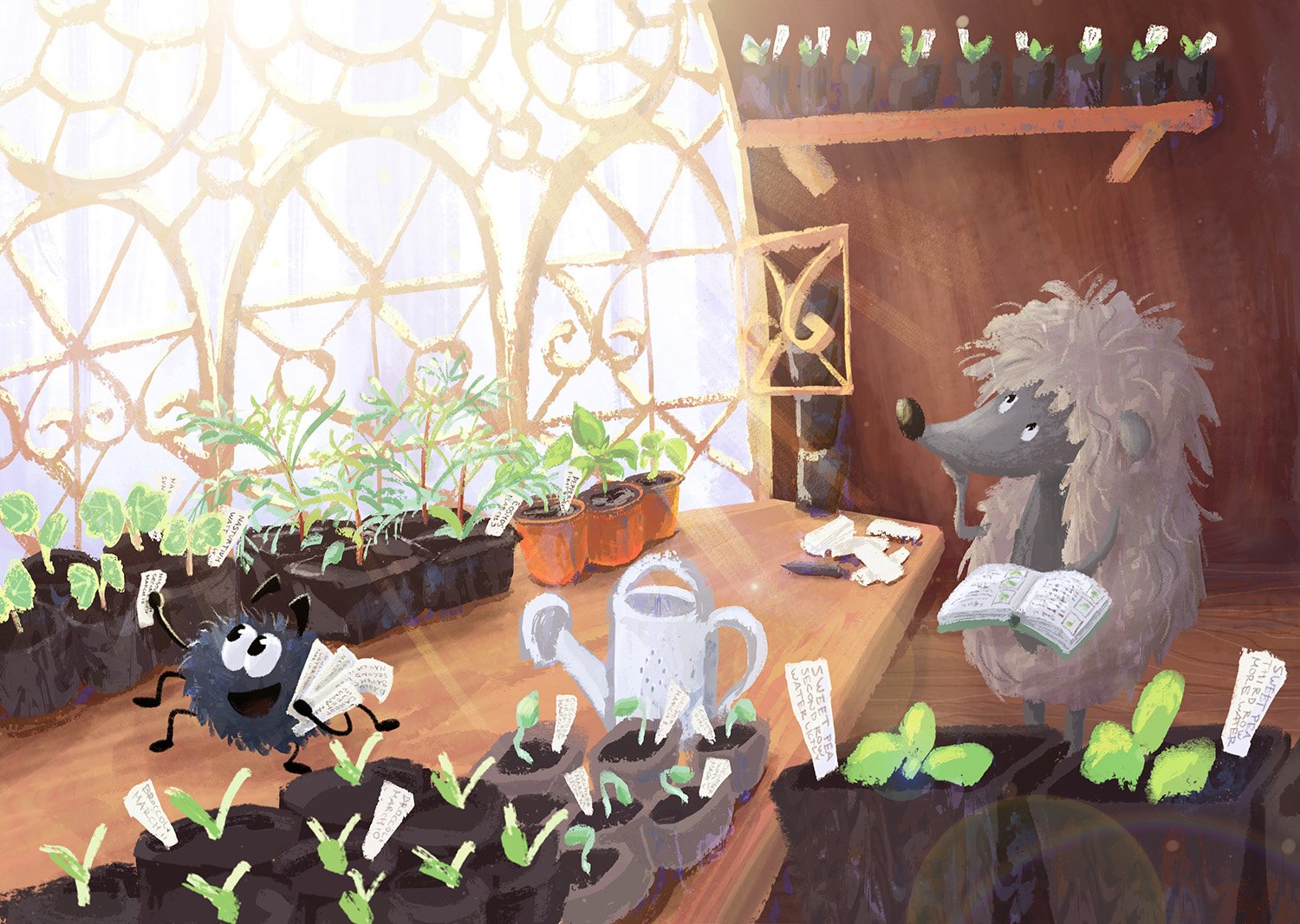
He leaned forward to check the tag. Of course, he knew all the plants by heart, but he liked order, and this habit was hard to break.
Each tag was carefully prepared. Not just a name, there were dates, written in small steady numbers. Row markings. Short notes: more sun, less water, slow to start, promising.
The tag in the next planter was missing. He checked another. Also no tag.
Yens frowned. Then he noticed the trail - tiny crumbs of soil leading toward a large clay pot in the corner.
“Spinny?”
Silence.
“Spinny, I need those tags.”
There was a small sound from behind the clay pot. A shift. Then stillness again.
Yens waited.
“I’m not upset,” he added gently. “But I do need to know what is what.”
A pause.
Then, with effort, Spinny appeared, dragging something behind him. Not one tag. All of them. They were gathered together with thread, wrapped and knotted into a long, uneven line that followed him. Spinny pulled the entire construction into the middle of the windowsill and looked at Yens with a proud squeak.
Yens leaned closer.
“I see,” he said.
Spinny waited.
“You’ve… connected them.”
Spinny puffed up.
Yens picked up one end. The rest shifted with it, several tags sliding at once, one flipping over, another slipping out from under the thread and landing softly.
“Yes,” he said slowly. “That does make them harder to lose.”
Spinny squeaked - exactly.
Yens nodded, then looked at the seedlings.
“The trouble is,” he said, “they are not all the same.”
Spinny paused. Yens turned one of the pots slightly.
“This one will need more sun,” he said. “That one - less water. Some will grow quickly. Some will take their time. And later, when they are outside…” he gestured toward the garden, “…they will all go to different places.”
Spinny looked at the rows. They did, in fact, look quite similar.
Yens flipped open his notebook. Inside, between notes and small sketches, were careful drawings - leaves, stems, tiny shapes, all labeled in a neat, steady hand. Yens pointed.
“This one,” he said. “Matches this.”
Spinny looked from the drawing to the plant. Then back again.
A small, thoughtful squeak.
“Yes,” said Yens. “The tags match the plants. Let’s try. Find that one.”
Spinny leaned in. Looked at the tags. Looked at the page. Then, with great confidence, grabbed the correct tag from somewhere in the middle of the long line. The rest followed. A loop caught on the pot. Spinny pulled. The pot stayed. Spinny did not. He landed in a small heap, still holding the correct tag.
A pause.
Spinny looked at the line. Then at Yens.
A quieter squeak.
“Maybe,” Yens said, “a little less of it.”
Spinny thought. Then he went back and untied a small section - not everything, just part of it.
He tried again. This time, he reached the planter. He placed the tag. He looked back. The line stretched, but didn’t pull him away.
Spinny brightened. He returned, untied another small section, and tried again.
And so it went.
Each time, a little less string. A little less trouble. Until at last, the tags were back in their places, and only three remained connected, for reasons known only to Spinny. He sat beside them, quite satisfied.
Yens closed the notebook.
“Well,” he said, “that was not entirely efficient.”
Spinny looked up.
“But,” Yens added, “it worked.”
Spinny beamed. He looked over the rows. Then, after a moment, he picked up the last three connected tags… and, with careful thought, separated one. Then another. He placed them properly, one by one. The final thread remained in his paw. He considered it, then tucked it away for later.
Outside, the garden waited.
Inside, the seedlings stood in quiet rows again.
And the tags, after a bit of effort, found their way back where they belonged.
